As we've read about in
Culture + Technology: A Primer and discussed in class, the western world believes that the advancement of technology equals progress. This is especially true of the United States since the days of Manifest Destiny when columnist John L. O'Sullivan wrote of our country as, "
destined to be the great nation of futurity." Since then, our nation has held a forward-thinking, advancement-driven mentality. With each advancement, from the the railroad to the internet, the idea of reaching point B from point A almost instantaneously has been the goal. But, let's narrow the field of view and focus on the advancement of a technology specifically engineered to instantly transport someone to not only a specific place, but also a specific time. No, not a time machine. I'm writing about the still camera.
 |
| Ansel Adam's "The Tetons - Snake River" c. 1942. |
Cameras can be traced back to, believe it or not, the early 11th century when Middle-Eastern scientists developed a device known as the
camera obscura. The problem with the technology? Early models were large, the size of a room to a house. Later models were scaled down to small wooden boxes, but it still produced just a tracing and an exact reproduction of that specific image was nearly impossible.
 |
| A simple camera obscura. |
The real revolution in photography came with a man named
George Eastman who began manufacturing celluloid to make photographic film to be used in his Kodak camera. Exposing Eastman's film to light resulted in a film negative which, when processed, could produce a print of an image in the proper perspective and color, or highlights and shadows in the case of black and white. From this point on, Eastman's Kodak cameras served to democratize still photography as Eastman's camera and film were sold to a mass-market at a cheap cost. However, Eastman's advancement also served as the broad commercialization of photography. One had to buy Eastman's camera, Eastman's film and ship the film off to Eastman's labs in order to processed.
 |
| An early Kodak Brownie c. 1910s. |
The advent of the modern-day 35mm
Single-Lens Reflex camera (SLRs) also marked another peak in the democratization and commercialization of the still photography world with the release of the Soviet "Sport." These 35mm SLRs eliminated the problematic phenomenon known as
parallax, infamous in
twin-lens reflex cameras, and introduced interchangeable lenses. This meant a photographer didn't have to be Ansel Adams, treking through the Tetons with a large format field camera. Instead, the photographer could buy a much cheaper SLR and cheap and easy to load 35mm film. Anyone could pick up this technology and, with some skill, create "professional" and "artistic" images, thus democratization. But, the advancement is two-fold, also aiding in its commercialization. Soviet companies like GOMZ competed with German companies like Zeiss and Japanese companies like Pentax for photographer's respect in the market.
 |
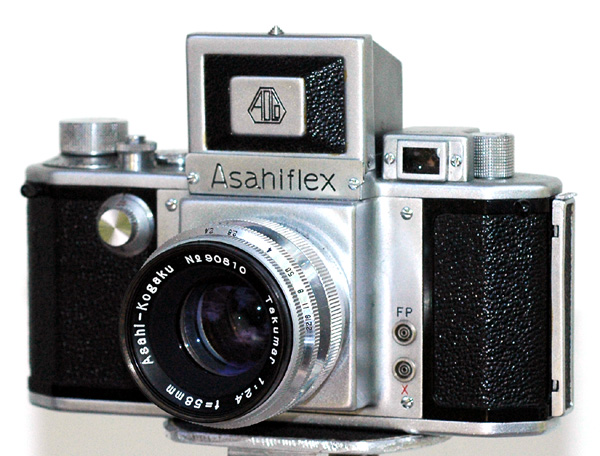
| The Pentax Asahiflex, the first Japanese SLR. |
Now, in the present day photography world, the market has changed once again with the
Digital Single-Lens Reflex camera (DSLRs), which has once again continued to democratize and commercialize the photography world. With light striking a cheap computer chip, film is no longer necessary, cutting down cost for the consumer. These DSLRs can be loaded with a memory card, capable of holding more pictures than a single roll of 35mm film could. These pictures, or files, can be uploaded onto a computer, edited and distributed and all by the photographer him or herself. This means cutting out the processing charges and giving the photographer complete control over the end result of the print. These DSLRs are even branching outside of the world of still photography and into the world of motion pictures as most of these DSLRs now support a High Definition movie mode. Not only are these cameras valuable to still photographers, but also to digital cinematographers. While standard HD camcorders are certainly able to shoot a movie, the DSLRs give the filmmaker the ability to use interchangeable lenses to create a depth of field similar to that of analog film. Actual movies can be shot on these cameras at low costs, giving power to the independent filmmaker. The video below is shot entirely on DSLRs, specifically the
Canon 5D Mark II and the
Canon 7D.
Though the features on these cameras open up a new world to filmmakers, it's also stepping up the commercialization. Canon, Nikon, Panasonic and others are creating lens adapters for their cameras to support other companies' lenses, meaning I could shoot footage on a Canon camera, but with a Nikon lens. The companies are stepping up their lens manufacturing, increasing cost, but also creating more selection and options in how one shooting his or her footage.
Basically, the advancement process is two-fold. It democratizes an industry while simultaneously commercializing it. Is it a bad thing? No. Photographers and cinematographers are always looking to push the medium to create more stunning and mesmerizing images. In order to make this new technology affordable for all, commercialization is inevitable. As long as the market is in healthy competition, we're going to see amazing still and moving images created by Canon, Nikon and Panasonic, among others. It's not the technology that makes photographers and cinematographers do what they do. It's the craftsmen behind this technology that will ultimately decide what to do with this technology.