Friday, April 15, 2011

The iPad Spider-iWeb

Yesterday, I was walking at work and saw a vendor displaying his x-rays on an iPad. Probably a year ago, he would have had a complex setup detailing with light boxes and x-ray film all over the place, but this is now. This is the future!
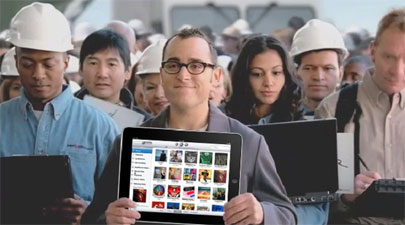
The iPad has “cyberized” our everyday life. It has redefined our social experience to be one of seamless access and seamless management. It has become the social revolution of our time and we are smack-dab in the middle of it. It has become the agent (Slack + Wise, 116). in the network of lives that allows us to actively move in and out of these spaces anywhere and anytime.


If thought in the terms of “iPad as Code,” I have come to realize that this piece of technological advancement has now become a part of my daily routine as putting on my socks and shoes in the mornings. I have to make sure I have it or something just seems missing. (Slack + Wise, 118). It has become more of a focal point than many of the other technologies I tend to hang off of myself each day. It is more accessible and versatile than my cell phone (besides making the calls) and more handy than the laptop.


It has its own nature - it’s small enough that it takes the place of calendars, planners, calculators, and maps. It is the Swiss Army knife of the data world.


It has its own language – It draws attention from the surrounding population. Life has begun to pattern itself around it. We now have iStores, iBooks, and iPets. The culture has shifted to one where if you place a lowercase ‘ i ' in front of your business’s name, it is assumed to be more successful.


The iPad in the office changes the entire space as if it was insignificant before its arrival. Take the iPad into a meeting where everyone else has the good old trusty pen and paper. Focusing on the presenter becomes more difficult due to onlookers trying to get a glimpse on not just the iPad itself, but at the change in function. You can type notes now. As the presenter mentions certain topics, you can look them up and follow along. Sure, laptops offer similar purpose, but the form just isn’t the same. There seems to be something about holding a small slab in your hand that screams confortable.


In this network, the iPad is the nucleus and all other of life’s functions are the nodes. This pertains to our individual lives, true, but it reaches to the global scale, as well. If a meeting can make onlookers feel left out because they don’t have an iPad to use, imagine the impact of the iPad on entire countries entails. (Slack + Wise, 121). If your nation offers the iPad, then the population feels as if they have access to the biggest and the best resources possible, which is why many countries vie to offer the iPad. It represents power. As we discussed in class, a “dead zone” on a network is a spot where not internet can be used or accessed. The global example works in the same way. You may have internet, Wi-Fi, and laptops on every street corner, but if you don’t have the emerging symbol of precedence, you feel simply left out and in the cold.


This shift has transfigured the way we think. It has affected us in fundamental ways. The power over the technology we create has now taken control over us and our lives. It not only affects us, but future generations to come. The digital age we have helped to create will become the digital norms of tomorrow. The iPad will become the dinosaur of the 2000s much like the console television has when compared to the flat screen 3D TVs of today.
(Slack + Wise, 123)

Bringing it back locally, the iPad has impacted the networks of my life, socially, spatially, and contextually.(Slack + Wise, 121). From my room, I can see Mars on the same surface in which I can deal with some disgruntle fowl, but the magical fact is that it actually works pretty well. It makes you feel powerful. It prescribes what advancement is supposed to look and feel like. And for all intents and purposes, it actually feels good. Happy reading (hopefully on your iPad)!
The term “cosmetics” comes from the Greek word cosmos, which represents “order.” Additionally, cosmos means, “order, ornament, world or universe” (Chico, 4). That is, there is an inherent link between cosmetics and norms and orders present in society. Cosmetics act as technologies of the body. Technologies of the body produce identities that either fit within social norms or outside of social norm. This is evident in my own experience as well as the use of cosmetics requires my dedication and the management of my body in order to promote and image.My "image" essentially acts to disguise my "self" through methods of concealment such as the use of cosmetics. "Kate" is essentially an image, ultimately managed and controlled through societal norms.

In Metaphors of Inscription, author Pippa Brush discusses the theoretical aspects associated with cosmetics use. For example, the author notes that, “Michel Foucault calls the body the 'inscribed surface of events.” That is, the body is malleable to outside elements. These elements are in fact elective but many theorists believe that individuals view these products as necessities.

In Foucault’s, Discipline and Punish, he introduces what he deems, “the power of the norm.” Here, it is the socially acceptable and almost necessary use of cosmetics by females. Foucault states, “ In a sense, the power of normalization imposes homogeneity, but it individualizes by making it possible to measure gaps to determine levels, to fix specialties and to render useful by fitting them one into another ” ( Foucault, 1979;184). The norm disciplines subjects through ranking individuals, demanding recognition and isolation of those persons and meanwhile demanding a homogeneous society. The body is no longer a concrete thing but it now “becomes plastic, inscribed with gender and cultural standards” (Brush, 25). Similar to this ideal, Mary Koust’s article, Flesh and Bone, applies to cosmetics as this technology uses the body as a medium or a raw material through which an “embedded sociology” exists. Bodies govern status, ranks and relationships through the identity the flesh creates. Agency becomes an issue as artificial meanings replace the self with an identity.

Cosmetic use poses multiple theoretical concerns and differing opinions on its application to ideological and aesthetic meanings and constructions. The Arts of Beauty: Women’s cosmetics and Pope’s Ekpharis, author Tita Chico examines Alexander Pope’s poem, “Rape of the Lock,” written in 1714, as it applies to beauty. Chico specifically highlights the idea of “management” of female beauty, revealing an ideology that functions both ideologically and aesthetically. Specifically, the character of woman is managed through increased or added dedication. Here, Chico views Pope as the manager of this imagined woman. This introduces the function of control as an instrument of power. Chico cites the definition of manage as to “make [an object] serve one’s purposes” (Chico, 2). The natural versus the artificial becomes confused as the cosmetics industry grew. However, even in Pope’s day Chico notes that he view the unadorned body as “only an object if curiosity, and that the cosmetically produced image of femininity produces awe and significantly, desire in those who view it” (Chico, 5). In other words, female use of cosmetics is designed for other’s gaze rather than for the user. I do not benefit personally, however, I benefit in social terms.

Theorist Laura Brown presents a Marxist feminist viewpoint furthering Chico’s discussion of management of woman’s beauty through objectification. Brown labels this objectification as a “structure of commodification.” That is, Brown explains a structure of commodification as, “exchange value comes to usurp use values, and relations between people, human beings, themselves can come to be re-defined as objects” (Chico, 4). This point posited by Brown also rings true in my personal experience. Before “going out,” I re-define my image to fit the particular situation or order, which I plan to enter. For example, if going out to a restaurant or bar at night, I will not be seen without mascara. Therefore, cosmetics act as a necessary commodity that comes at both a literal and figurative price.

Similarly, in Kathy Peiss’ works, Hope in a Jar and Making Faces, she notes the societal shift toward the body as a social construction. Brush discusses Peiss work specifically as it deals with attitudinal changes of cosmetics uses throughout the twentieth century. Brush furthers, “Peiss uncovers the role of the emerging industry in constructing a desire for cosmetics in a society which had previously viewed their use as ‘symbols of rampant and material excess,’ but which came to understand cosmetics as ‘respectable and indeed necessary for women’s success and fulfillment” (Brush, 38). In essence, this view represents a postmodern concept of the body as text. Brush describes this function as the “material praxis of construction of that specific; the grueling and continual maintenance of the self-created body is deliberately ignored and only the completed (but always provisional) text is offered to the reader” (Brush, 32). Debates continue over whether cosmetics act to degrade or empower women.

In my own experience, I agree with the concept of cosmetics use as a function of “management.” That is, I curl my eyelashes, put on mascara, and apply foundation. Why? Do I benefit from the application of artificial ingredients to my flesh? No, I do not benefit. However, benefits arise in terms of society. Because I wear makeup, society views me as “normal.” That is in a sense I achieve obscurity through compliance with societal norms by acquiescing to the powers that control. That is not to say that I must use cosmetics to be a beneficial member of society, I do, however, need cosmetics to appear more attractive and normal while benefiting society. This reiterates Foucault’s notion of maintain the body. In a sense my use of cosmetics maintains the social order and regime of truth of which I am subject.

Sewer Monsters and Women Sitting on Curbs


Take a good look at the picture above?  I'm willing to guarantee you have never been to this location, but hopefully, if the photographer has done his/her job, you're able to "transport" yourself to this location and feel and relate to this place, even without having been there.

As it turns out, the photographer of this picture "The Sewer Monster" is photographed and processed by me, Andrew Gafford.  If I have done my job correctly, as Ansel Adams defines as, "a great photograph is one that fully expresses what one feels, in the deepest sense, about what is being photographed," you the viewer get the sense of childhood imagination, being able to see two eyes and a mouth in this drainage area.  Even though you have never experienced this spot like I have from my childhood, the photograph is meant to express that childlike wonder I felt when I first encounted "the sewer monster."  Like I mentioned in my previous blog, that is the power of the camera's product.  It transports the viewer to a time, place and feeling even though they may never have been there before.


Still from William Eggleston in the Real World.
Being able to feel transported is all well and good.  It certainly in the power of art, but how does using a camera affect the photographer?  My previous post looked at how photographs affect the viewer and their gaze, but the photographer's gaze in relation to the subject is different than that of the viewer and the subject.

Ulrike Gretzel's "Travel in the Network" describes the "tourist's gaze" as "the organized and systematized way in which tourists look upon landscapes, natives, historical sites and other objects of interest" (Gretzel, 45).  The article specifically looks at how using mobile phones affects the tourist's gaze, but it can directly relate to how the camera affects that gaze as well.  


From William Eggleston's Memphis, c. 1969-1970.
No photographer is more famous for his depictions of everyday, mundane subject matter than William Eggleston.  Take a look at the photo above.  If you're like me, you get a sense of this woman, her life and the time period in which this photo was taken.  I am transported.  But how is one affected when they are the one actually snapping the picture?


As Marshall McLuhan wrote in Understanding Media, "technologies used by tourists to gaze at objects frame the view, change patterns of perceptions and also create a barrier between the tourists and the objects of their gaze."  The Gretzel article argues that using technologies like cellphones in the experience of travel changes the experience from the real to the virtual.  The same can be said of using a camera.  Instead of actually engaging the surroundings, tourists will use their cameras to snap pictures of the surroundings.  This is a drastically different experience and is not a true engaging of the surroundings.  Photographer William Eggleston spent years in the Mississippi Delta, living and experiencing the culture and people of the area.  His photographs evoke that sense of a recreation of real life events and people.  Without this connection, the photographer falls victim to a false sense of reality, trusting the representation of space, the photograph, as the experience, rather than first experiencing the area in a real, engaging way and then crafting a representation of space.


The way I have used cameras, like in "The Sewer Monster," is through a deep emotional connection with the area, like that of Eggleston.  Contrast that against how our book describes the tourist's gaze.  Without any sort of connection to the place, tourists snap pictures of the area, claiming to have had an experience or connection with the place, when in actuality all they have been doing is hiding behind a screen and creating an almost meaningless representation of space.


The camera, particularly digital cameras, allows its users to quickly snap pictures, upload them onto a computer and then the internet, creating a web of virtual "experiences" without anyone ever having actually experiencing the real deal. What's important to remember when either using a camera of looking at photographs is this:  How is this technology affecting the way you view the world?  Trusting the camera and photos to experience life for you is problematic.  Always strive experience the real, not the digital or virtual.

My mom died yesterday. What? My mom... nevermind.

There is a blog on slate.com written my Nikki Saval that gives some pretty insightful points to the obstruction of the iPod. With the birth of anything there is radical change created for those in its immediate proximity so it is true with the iPod. The iPod has revolutionized culture only for those who can get their hands on an iPod. In her article Nikki Saval discusses George Steiner and Alan Bloom discussing recorded music and its affect on society even in the 1960's and 70's. She mentions that the panopticon of the theatre began to lose ground to the privacy of the home stereo and the gramophone.


In my experience with the iPod life is introverted. I am connected to a device that bends to my will and expresses me to me whenever I want and without questions. My iPod allows me to show myself what I want and I can administer that in the form of music. I ask my self the question, "What are you feeling like right now?" and I can answer myself with, "angry". Then I can satisfy my desire for an angry companion by turning on death-core or any of the other obnoxiously disinfranchised bands that whine and complain about life's miseries. This is the same argument that President Obama brought of in his commencement speech to the University of Michigan a year into his presidency. He voiced that he worries that the highly polarized few can hide themselves in the far reaches of misinformation and validate themselves in their behavior because media has become so large and so polarized and uses such ambiguous information that the angry can stay angry and the corrupt can stay corrupt and never have to face the fact that they might be fueled by false allegations.

My iPod allows me to travel alongside thousands without having to deal with a single soul. I can listen to this device and it articulates my deepest desires directly back into the drum of my ear. I don't have to look anywhere else for relationship or connection that might make me uncomfortable but instead through my iPod I can isolate myself from the world around when all gets too overwhelming.
I can not begin to fathom the neurological weaknesses created by this mental and social pacifier. This, however, is not only an implication I have developed, but the authors of our book write this piece into even the introduction when they say, "Even the lines between industrial technology, communication technology and biology have been blurred beyond meaningful distinction." The problem is this, the iPod from my understanding was never created to be biological technology but somehow it has become a medicine that need not be prescribed. Parents use this technology to pacify their children at restaurants, individuals use it to cope with the world around them, and I use it because I have an obsession with music that can not be quenched by a single cd or the radio, I need to be in control of this device.

This technology is nonparticipatory in some regards in that I do not get to choose what the headphones feel like, I don't get to choose how to input the music, I don't get to choose the shape, or features of this device and I certainly don't get to choose its price. This however, does not stop me from surrendering to the hours of learning how to make it function properly, the sore ear holes because they were not made to fit mine, the awkward shape of the device and not knowing how to carry it because if its in my pocket the cord yanks on my ears and if its in my hands I am restricted from doing particular things. I don't want to lose it because it is expensive and so I have to constantly be watching it if I am not using it. Somehow even though this technology is suppose to be convenient I allow it to inconvenience me because the opportunity cost of those inconveniences far out weighs having to strike up a conversation with a long lost friend on campus or having to engage in the classroom with information that might actually put my brain to work. We no longer enjoy conversations on long car rides and listen to each other and the depthful things we might need to share, but instead sit back, plug the ears in and drown in a sea of musical solitude.

These Are My Shoes!


Shoes are the best gift on earth giving to a woman. Well at least in my opinion. Shoes are the necessary accessory on a persons’ outfit. Shoes will do one or two things when it comes to dressing up. It would define who you are or change who you are. To me shoes change your character and help you to feel confident in your own skin. A good pair of shoes would have a persons’ self esteem, extremely high. In our textbook Culture and Technology it states, “Makeup is used to alter one’s appearance to fit within cultural norms of attractiveness and to exaggerate of emphasize gendered characteristics of appearance, such as the eyes or lips,” (Slack 161). A woman wearing a nice dress with makeup and man wearing a nice color suit might bring out their features slightly. On the other hand; putting on some attractive shoes would bring out the personality and life within that person. In Pat Gill article she stated, “The social categories of race, class, and gender are acknowledged only to be proven insignificant,” (Gill 170). In the case of shoes, these social categories are unworthy if the shoes are not attracting attention and confident goes unnoticed on the person. The use of shoe technology is very necessary in my life because it defines me of who I am today. Shoes bring out my outfits, legs, but most of all, my cocky attitude. I am sure a lot of ladies can relate to the time when they first put on a pair of their mother’s high heels. A question may come to mind, why do little girls put on their mother shoes in the first place? When a young girl puts on her mother’s shoes it makes her feel grown, brave, cute, but most of all sexy.

High heels identify a woman as, sexy in today’s society. This is one major reason why I wear four inch high heels. Over the decades high heels earned the nick name, “sexy woman,” because at one point they were consider, “prostitutes.” In the 1960’ and 70’s a woman was consider a prostitute if she wore high heels. How does society come up with these names over a period of time? “We are increasing incapable of fashioning representations of our own experience, that we turn fashioning nostalgic re-vision,” (Gill 163). Shoes have been taken to another level. Many times it is celebrities we turn to for style because we are afraid of having our own style. In order for me to know the latest trends on shoes I look in magazines and on television. Have you ever notice there are different types of shoes for different situations? Why is this? When designers make heels they assume you can walk in them, the same with men and steel toe boots. In our textbook Cultures and Technology it states, “Technologies often impinge unequally on those with different abilities. Most technologies assume that the users are able bodies,” (Slack 159). Men Gator shoes are design for men with money and confidence. High heels from all nature are design for women with attitudes and confidence. Just like me, Teonna’Joy!

Cites: Slack, Jennifer Wise, J. MacGregor. Culture and Technology.

Gill, Pat. Technostagia: Making the Future Past Perfect.

The Miracle Drug

As long as I could remember, I always used Advil to relieve pain from my body. I always remember going to the medicine cabinet and reaching for the Advil bottle when I had a headache, muscle pain, toothache, etc. In retrospect, Advil and ibuprofen has been very important in my life. As a child, I could remember coming home in pain from straining my ankle I suffered at football practice and my Mother would give me two Advil tablets and a glass of water to help swallow the tablets. The next day my ankle felt better and ever since that day I have always referred to Advil as the miracle drug. My ankle healing by the next day could be an example of Cyborg Identity. Advil is a medicine that heals and repairs my body from pain. In addition, referring to chapter ten, Advil agencies communicate to the public that it is representing a form of human medical improvement. I become dependent on Advil whenever I’m in pain. For example, page 118 in the textbook mention that technology has actors and one example of an actor is when people become dependent on technology for a specific function. Whenever I have a headache or toothache, I become dependent on Advil to relieve the pain. Chapter ten also talk in-depth about the Actor-Network Theory to better explain what technological agency is. Actor-Network Theory provides models of actors, translation, delegation, and prescription. Advil used in the term of delegation that means representing something or someone on its behalf. The textbook explain that delegation is when technology does something we wish we can do or no longer have to do anymore. With the invention of Advil and ibuprofen, I no longer have to find other forms of reducing pain from my body. Just like with technology and space, Advil made it were I no longer have to miss work because of a mild headache and not earn money for that day or go to the dentist for a toothache. For me Advil is more reliable and convenient than spending money going to doctor or lying in bed hoping the pain goes away. Prescription is defined as behaviors, attitudes, and values. On page 120 in the textbook, it explains that since the invention of the bread maker, we are expected to produce fresh bread. As related to my personal experience, many jobs expected me to come to work no matter what the degree of pain. Telling your employer that you are not coming into work because of a headache or toothache is no longer a good excuse. Most companies I have worked for carry Advil or ibuprofen in the first aid kit. Two years ago I was dealing with a very painful toothache on a top right that I had a root canal on three years previously. When I called my job to inform that I will not be coming to work because of the toothache, the supervisor told me if I can try to deal with the pain and to just keep taking the Advil’s out of the first aid kit throughout the entire time I’m at work. When I made it to work, many co-workers and managers express the feeling that a toothache is no longer a serious reason to miss work. Even in college, a toothache, headache, or other body pains is not a good excuse for an excusable absence for many professors unless I have a doctor note. The supervisor, co-workers, and professors showed an attitude that with the progress of modern medicine; only a serious illness could be the only excuse of absence. This is an example of people attitude and behavior towards mild body pain with products such as Advil now being available. The conversation with the supervisor is also an example of actors being a mediator. Advil was the mediator between me and the supervisor. When the supervisor asked me if I could take Advil’s while I’m at work, became example of the supervisor using Advil as the mediator to get me to come to work. Having a toothache would have been an acceptable excuse for not coming in to work, if it was not for invention of ibuprofen. Ibuprofen is a more reliable way to keep people from having a high absent rate. The textbook mention that Actor-Network Theory explain that technology make people respond in a certain way. From what I experience, people respond to others with mild body pain as not being a great concern. As mention at the end of chapter ten, technology change the everyday encounters we have with people. People was not compassionate that I was in pain because of a toothache. The people I thought would be more compassionate turn out to not be. We have this attitude now, because ibuprofen is something that is now looking at as universally available. Advil is a stronger and reliable network for relieving pain than going to the doctor and spending more money or using a home remedy that might less reliable than taking a simple Advil tablet. In conclusion, the companies I worked for depends on medicine such as Advil, as an actor agency to keep their workers from being absent.

Daryl Slack, Jennifer and Macgregor Wise, J. Culture and Technology. New York, NY: Peter Land, 2005. Print.

From Dyson to Rosey

The vacuum cleaner plays a large role in American life and many other cultures and countries. Over the years, the vacuum cleaner has evolved and has been tailored to fit the human being. Growing up, I came from a large family, three girls and three boys, and also cousins around the same age as me. Our ages ranged from three to twelve and I can remember us arguing over who would vacuum the floor because back then, we thought it was fun! It sure was a lot different from sweeping the floor.

Today, although I don’t continue to have those same fond feelings for vacuuming, my vacuum cleaner plays an intricate role in my life. I have a dyson vacuum cleaner, might I add a great brand that is almost conjoined to my hip at home. I use it to vacuum small messes, cobwebs, cracks, crevices, and periodically, I even vacuum my mattress to ensure that there are no dust mites. Because my vacuum cleaner has so many functions and it is so convenient, I even use it to vacuum out my car. As stated above, I came from a pretty big family and growing up in such a large household, the vacuum cleaner did not really have a gender assignment, it was just something that we all did. Although I see vacuuming as a gender neutral technology, society as a whole does not.


According to Friedan’s The Feminine Mystique, between the 1940’s and 1960’s, the idea of the woman evolved from independent career oriented to “happy housewives” whose entire focus was family and home. During these times, post Cold War and World War II, the identity of many women was questioned. Women had been letting go of their own dreams to conform to the societal correct role of “housewife.”

If viewed from a culturally deterministic perspective, you could say that the vacuum cleaner was designed just for women. According to our textbook, technology is unequally prescribed and it makes assumptions of design and system which all tie into our identity. The vacuum cleaner is lightweight, small, easy to use and maneuver, and in some period in time, you could say was designed specifically for women. Not only that advertisements and social standards also tie into the gendering of vacuum cleaning. Essentially, the job of cleaning the floor has been delegated to the vacuum cleaner.


In a changing world, the roles of men and women are nowadays, interchangeable. Now you have stay at home dads and women who go out and work. You find husband and wives sharing the household chores because they both have careers. Furthermore, the “housewife” is not even that anymore. It is more common to find “life partners” or common law marriages. Sooner or later you will not have to worry about gendering technology because…technology will be in a category all by itself. In the concluding part of our textbooks, it tells us that robotic productions are aimed at now producing robots that will function seamlessly as part of our everyday life by building human like behaviors, responses, emotions, etc.!!! So when the role of the vacuum cleaner is spoken of, it is not that of gender, but, the new being, THE ROBOT.